
Rethinking Compute: Smarter Chips, Less Power, and the Future of Streamlined Processing
The Compute Crunch
We’re living in an era shaped by AI. Every swipe, voice command, and AI generated search requires an algorithm that needs serious compute power to function. The adoption of AI in almost every facet of daily life requires an advanced computing infrastructure that is hitting power and efficiency limits fast.
With AI models ballooning in size and cloud services demanding more processing, we need to ask:
Is there a smarter, more efficient way to compute?
Where We Are: The Von Neumann Bottleneck
The dominant architecture in computing, Von Neumann, requires data to shuttle back and forth between memory and processing units. This constant movement causes what engineers call the Von Neumann bottleneck—a major drag on speed and energy efficiency.
Every:
memory fetch
processing cycle
and storage operation
…adds to the energy bill and slows down the pipeline.
Smarter Computing: Rethinking the Flow
This bottleneck isn’t a technical inevitability—it’s an architectural legacy. Researchers and chipmakers are now challenging this model to build something radically better.
This is how Innovation is redefining how we compute:
In-memory computing
: Reduces the distance data travels, making processing much faster and leaner.
Neuromorphic chips
: Mimic the brain to handle tasks in parallel, especially useful for perception and AI.
Reconfigurable computing (FPGAs)
: Tailor chip behavior to a task, reducing overhead.
Event-driven computing
: Only wakes up the chip when needed, saving battery on edge devices.
These solutions eliminate unnecessary steps, compressing the compute pipeline and reducing power use dramatically. Advancements like these are necessary as AI continues to be more commonplace in today’s society.
Why This Matters: Power, Cost, and the Planet
AI is rooted in innovation, therefore the chips required to support the AI algorithms must also stem from innovation. Creating a solution that can support AI operations and the planet is the only sustainable way to expand this technology. Let’s ground this in reality:
Data centers already consume ~3% of global electricity, and this number is projected to rise rapidly
Mo, R. et al., 2025, IEEE Transactions on Cloud Computing
Large AI models like GPT-4 can require hundreds of megawatt-hours to train.
Cooling infrastructure in data centers is now a multi-billion dollar industry, driven by excess heat from inefficient compute architectures.
In short, the status quo is unsustainable. Smarter compute architectures can help:
Reduce global power demand
Extend battery life for mobile and IoT devices
Cut infrastructure and cloud costs
Lower carbon footprints across industries
The Awareness Gap: Why Aren’t More People Talking About This?
Most developers and product teams focus on frameworks and cloud providers. Rarely do conversations zoom in on chip architecture. That’s a problem.
Why the blind spot?
Hardware choices are abstracted away in modern dev environments.
Chip startups don't get as much airtime as cloud providers.
Power and efficiency improvements are harder to market than speed benchmarks.
But efficiency isn’t just a backend concern anymore—it’s becoming mission-critical for everything from mobile UX to sustainability.
Compute Consciousness
We need a shift in mindset from “how much can we compute?” to “how well are we computing?”
That means:
Asking vendors about architecture-level power optimizations.
Supporting chipmakers that build in-memory and neuromorphic solutions.
Investing in software stacks that play nicely with streamlined computing hardware.
The next great leap in computing won’t be more of the same — it’ll be less wasteful and more aware.
Streamlined Compute is the Future
Efficiency isn’t an optimization — it’s a strategic priority. Streamlined compute architectures that cut out unnecessary processing steps are quietly reshaping the future.
The real breakthroughs aren’t always louder or bigger—they’re smarter.
Non-Von is such a breakthrough
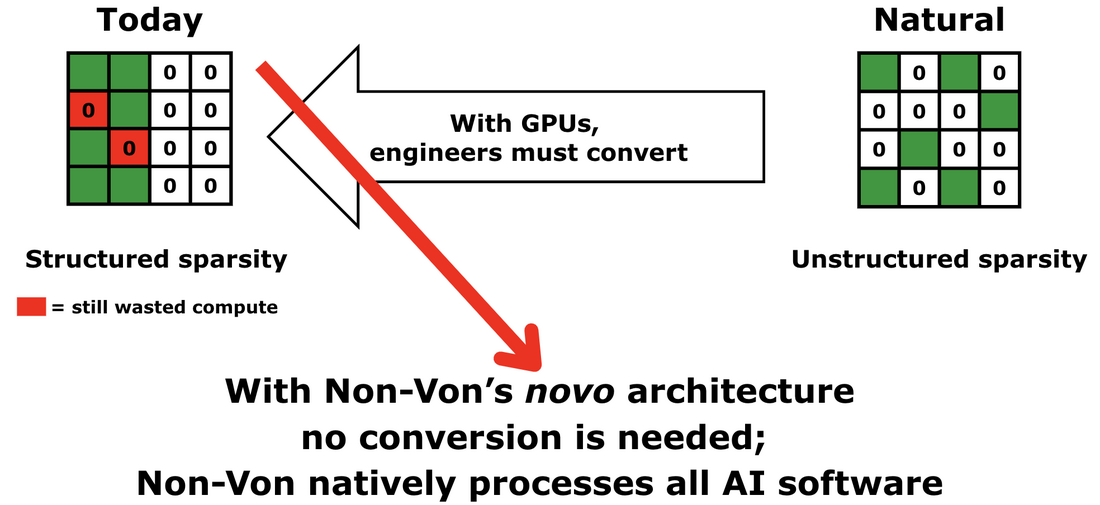
. We eliminate waste across the AI landscape. Our novel architecture and supporting software platform make it easy to be more efficient. We enable model builders to leverage any kind of sparsity, including unstructured sparsity (something GPU’s cannot do), this means that the entire post-pruning model conversion step can be eliminated!
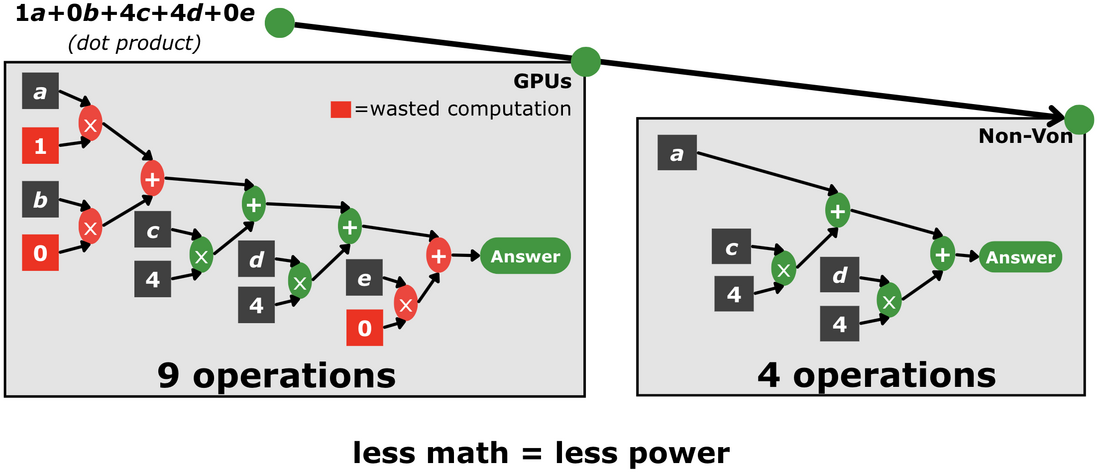
Our architecture and SDK also enable the elimination of wasted compute at the granular level of computations. In the simple dot-product below, a common function in matrix algebra, we can eliminate 5 of the 9 operations. Scaled to the AI model level we are talking about millions of calculations eliminated, saving compute across the board!
And we do it all while allowing developers to continue to use their current coding platforms such as PyTorch, ONNX, or Tensorflow; just a few lines of user code enable models built in these languages to leverage our novel AI processor.
Citations & References
Mo, R., Lin, W., Zhong, H., Xu, M., & Li, K. (2025). A Cross-Workload Power Prediction Method Based on Transfer Gaussian Process Regression in Cloud Data Centers. IEEE Transactions on Cloud Computing. https://ieeexplore.ieee.org/abstract/document/11021285/
Yu, G., Wang, Z., Xu, Y., Javan Shun, Z., & Chen, S. (2025). From Energy to Ecology: Decarbonization Pathways for Sustainable High-performance Computing. Frontiers in Applied Mathematics and Statistics. https://www.frontiersin.org/articles/10.3389/fams.2025.1595365/full
Curious how the novo architecture could accelerate your workload? Reach out to our team.